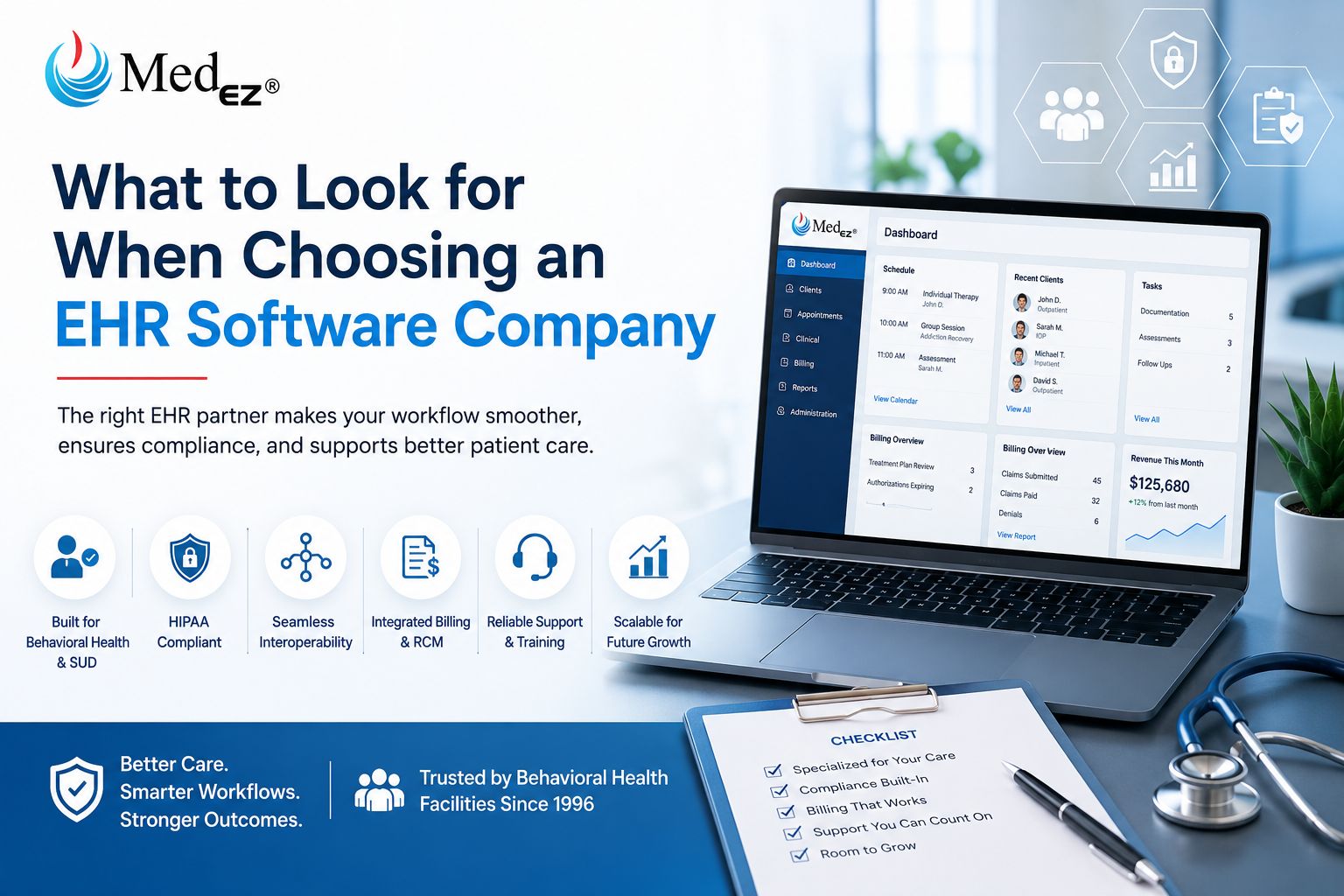
Choosing an EHR system isn’t like choosing any other piece of software. Once your clinical and billing staff have learned a platform, switching to a new one is slow, costly, and disruptive to patient care. That’s why the vendor you choose matters as much as the software itself.
Behavioral health and substance abuse treatment facilities are working under tighter compliance requirements, closer payer scrutiny, and thinner staffing margins than ever. A good EHR partner should make daily work easier, not add another layer of complexity. Here’s what to look for before you sign a contract.
1. Real Experience with Your Type of Care
A generic medical EHR built for a family practice won’t handle the documentation, treatment planning, or level-of-care tracking that a behavioral health or SUD program requires.
Ask any vendor:
- How many behavioral health or SUD facilities do you currently support?
- Does your platform handle both inpatient and outpatient workflows?
- Can it manage ASAM criteria, treatment plans, and group session notes out of the box?
A company that has spent years focused on one type of care, rather than trying to serve every specialty at once, usually understands the day-to-day problems your staff runs into.
. HIPAA Compliance Built Into the System
Every EHR vendor will claim to be HIPAA-compliant. The real question is how that compliance shows up in daily use.
Look for:
- Encrypted data storage and transmission
- Role-based access controls, so staff only see what they need
- Audit trails that log who accessed a record and when
- Built-in alerts and documentation standards that keep you audit-ready without extra manual work
Compliance should not depend on staff remembering an extra step. It should be built into how the software works.
3. Interoperability With Other Systems
Your EHR does not operate in isolation. It needs to exchange data with labs, pharmacies, referral sources, and other providers involved in a patient’s care.
Ask whether the platform supports:
- HL7 data exchange standards
- API connections to outside systems
- Secure export and import of patient records when a client transfers care
Interoperability protects continuity of care, and it saves your billing and clinical teams from re-entering the same information twice.
4. Billing and Revenue Cycle Support, Not Just Clinical Tools
Many EHR platforms handle documentation well but treat billing as an afterthought, and that gap costs facilities real money. Look for a system where clinical and billing functions live on the same platform, covering:
- Claim scrubbing before submission
- Electronic claims processing
- Denial management and resubmission tracking
- Reporting that shows where revenue is getting stuck
It’s more common than you’d think for a facility to switch EHR vendors specifically to fix billing problems. Getting this right from the start avoids that headache later.
5. Deployment Options That Fit Your Infrastructure
Not every facility runs the same IT setup, and your EHR shouldn’t force you into one. Before choosing a vendor, confirm what deployment models they actually offer:
- Web-based, for remote access and lower upfront IT costs
- On-premises, for organizations with specific data hosting requirements
- Hybrid, combining both depending on department needs
A vendor that offers only one option limits your flexibility as your organization grows or changes.
6. Implementation, Training, and Ongoing Support
The software is only as good as your staff’s ability to use it. Before signing, ask what’s actually included in onboarding:
- A structured implementation and assessment process
- Staff training, not just a manual or a video library
- A real support line, with response times you can count on
- Access to account specialists who know your facility, not a rotating call center
Vendors that treat support as a separate paid add-on often leave facilities stuck when something breaks mid-shift.
7. Room to Grow with You
Your facility today might not look like your facility in three years. A good EHR company should support that growth rather than force a costly migration later.
Check whether the platform can:
- Add locations or programs without starting from scratch
- Scale reporting and analytics as your data grows
- Support multi-location administration from one central system
8. A Track Record That Predates the Trend
EHR software has become a crowded market, and new vendors appear every year promising modern interfaces and AI features. Longevity still matters. A company that has supported facilities through multiple waves of regulatory change, payer requirements, and technology shifts has proven it can adapt without leaving clients behind mid-transition.
MedEZ®, for example, has been building behavioral health and substance abuse EHR software since 1996 and continues to serve facilities across the U.S. and internationally, including the Middle East. Three decades of focus on a single specialty isn’t something every vendor can claim.
9. Total Cost of Ownership, Not Just the Sticker Price
The lowest quote is not always the lowest total cost. Before you compare prices, ask what’s included and what’s billed separately:
- Setup and implementation costs
- Staff training
- Technical support
- Optional add-ons, such as consulting or billing services
A platform that costs a little more upfront but includes training, support, and implementation often ends up costing less over the life of the contract than a “cheaper” system with fees attached to everything.
Also Read: Modernizing Care: The Transition from Paper Charts to EHR Software in Behavioral Health
Questions to Ask Before You Sign
Bring this list to your next vendor demo:
- How many facilities similar to mine do you currently support?
- What does implementation actually look like, week by week?
- Is billing and revenue cycle management built in, or a separate product?
- What deployment options do you offer, and can I change later?
- Who do I call when something is not working, and how fast do they respond?
- How long has your company been in this specific market?
FAQs
What is the most important feature in a behavioral health EHR?
Specialization matters most. A system designed for behavioral health and substance abuse care handles treatment planning, level-of-care documentation, and compliance requirements that a general medical EHR isn’t built for.
Does an EHR company need to offer billing services, or just software?
It helps significantly. Facilities that use a single platform for clinical documentation and billing tend to see fewer errors and faster reimbursement than those juggling separate systems that don’t talk to each other.
Is cloud-based/web or on-premises EHR better for behavioral health facilities?
It depends on your IT infrastructure and data requirements. The better question is whether your vendor offers both, so you are not locked into one model as your organization’s needs change.
How long should an EHR company have been in business?
There is no fixed number, but a longer track record in your specific specialty is a reasonable signal of stability. Vendors that have supported facilities through years of regulatory change have already proven they can adapt.
Choosing an EHR company is a long-term decision, not a one-time purchase. Take the time to ask the hard questions before you commit, because the right partner will still be supporting your facility years from now.
MedEZ® has provided behavioral health and substance abuse EHR software since 1996, with integrated clinical, billing, and compliance tools built for inpatient and outpatient care. Request a demo to see whether it fits your facility.
Also Read: 7 Features Behavioral Health EHR Software Should Have to Support Indiana DCS KidTrak Reporting