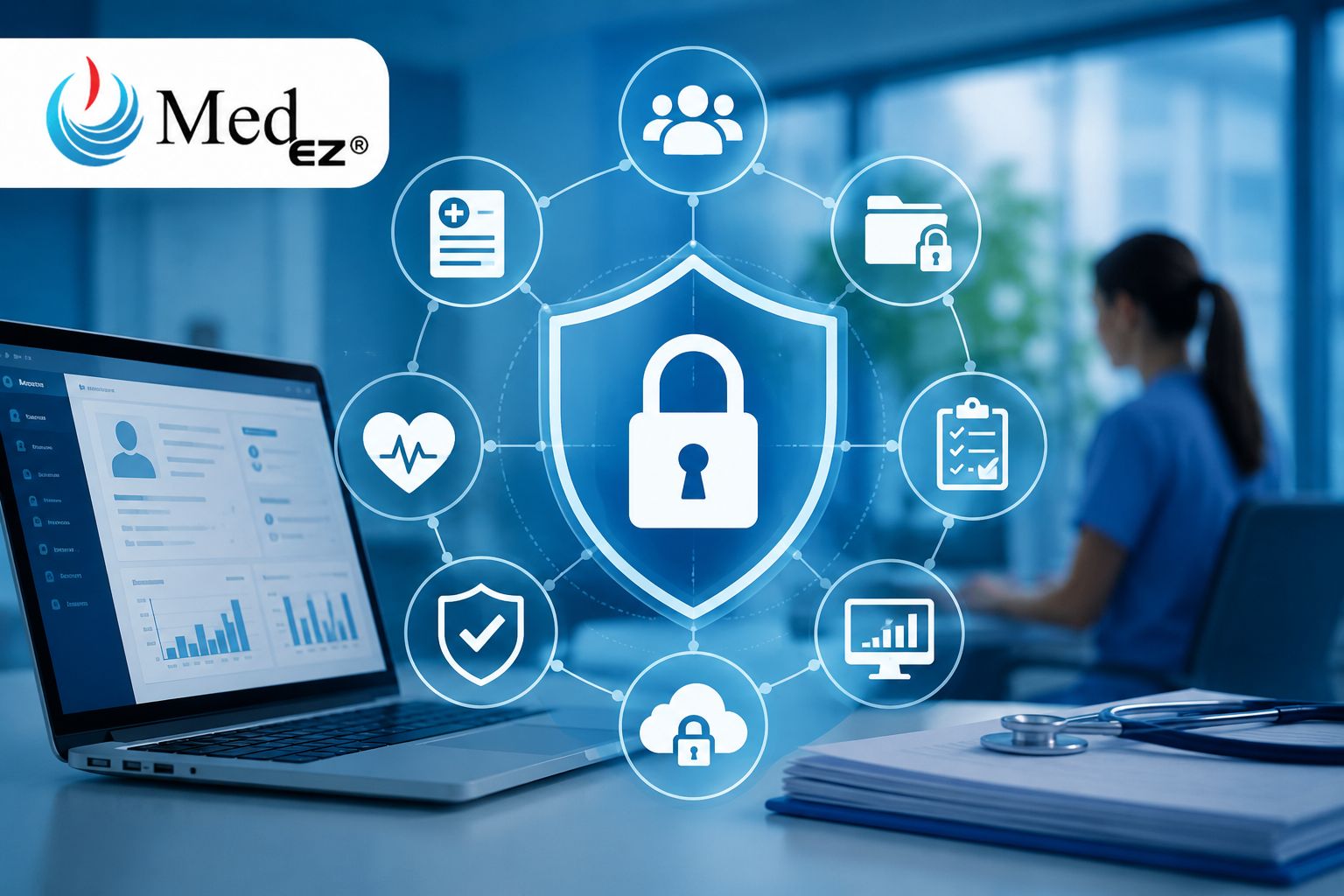
If you operate a behavioral health or substance use disorder treatment organization, protecting patient information is more than a regulatory requirement; it is fundamental to delivering quality care and maintaining patient trust.
Behavioral health records often contain highly sensitive information, making them a frequent target for cyber threats and unauthorized access. At the same time, providers must balance security requirements with the need for efficient clinical workflows, accurate billing, regulatory compliance, and coordinated care.
This is why selecting a HIPAA-compliant Electronic Health Record (EHR) system is one of the most important technology decisions an organization can make.
However, HIPAA compliance is about far more than simply storing records electronically. A compliant EHR should provide the tools, controls, and workflows necessary to help organizations protect patient information while supporting day-to-day operations.
Here are seven essential features every HIPAA-compliant behavioral health EHR should provide.
1. Role-Based Access Controls
Not every staff member should have access to every patient record. A HIPAA-compliant EHR should allow organizations to control access based on each user’s role, responsibilities, and level of authorization. Clinicians, billing staff, supervisors, administrators, and support personnel often require different levels of access to patient information.
Role-based access controls help organizations:
- Limit access to sensitive information.
- Support the principle of least privilege.
- Reduce the risk of unauthorized record access.
- Strengthen organizational security policies.
The ability to define and manage user permissions is one of the foundational components of HIPAA compliance.
2. Encryption and Secure Data Protection
Patient information should remain protected whether it is being stored, transmitted, or accessed.
A secure EHR should utilize industry-standard encryption technologies to safeguard electronic protected health information (ePHI) both at rest and in transit. Additional security measures such as secure authentication, password policies, session timeouts, and multi-factor authentication can further reduce risk.
Strong data protection measures help organizations:
- Protect patient confidentiality.
- Reduce exposure from cyberattacks.
- Support HIPAA Security Rule requirements.
- Minimize the impact of unauthorized access attempts.
Security should be built into the platform, not added as an afterthought.
3. Comprehensive Audit Trails
HIPAA requires organizations to maintain accountability for access to patient records. A compliant EHR should automatically record system activity, creating a detailed audit trail that tracks who accessed information, what changes were made, and when those actions occurred.
Audit logs support:
- Internal compliance reviews.
- Regulatory audits.
- Security investigations.
- Risk management initiatives.
When questions arise regarding record access or documentation changes, audit trails provide the transparency needed to investigate and respond appropriately.
4. Compliance-Focused Clinical Documentation
Documentation plays a critical role in both patient care and regulatory compliance. A behavioral health EHR should provide structured clinical workflows that help staff complete required documentation accurately and consistently. Features such as customizable forms, required fields, electronic signatures, treatment planning tools, and documentation alerts can help organizations maintain complete and compliant records.
Benefits include:
- Improved documentation consistency.
- Reduced compliance risk.
- Better clinical oversight.
- Stronger support for audits and accreditation reviews.
Well-designed workflows help clinicians focus more on patient care and less on administrative burdens.
5. Integrated Clinical and Billing Workflows
Disconnected systems often create inefficiencies, duplicate work, and billing errors. An integrated EHR connects clinical documentation, scheduling, billing, and revenue cycle management within a single platform. This allows information entered during care delivery to flow directly into billing processes, reducing manual entry and improving accuracy.
Organizations benefit from:
- Fewer documentation-related billing errors.
- Faster claim submission.
- Improved reimbursement performance.
- Better visibility across the patient journey.
For behavioral health providers, integration can significantly improve both operational efficiency and financial performance.
6. Reporting and Audit Readiness
Healthcare organizations rely on data to manage compliance, monitor performance, and support decision-making. A HIPAA-compliant EHR should provide reporting tools that allow administrators, supervisors, and compliance teams to access the information they need quickly. This may include operational reports, billing reports, productivity metrics, compliance dashboards, and clinical outcome data.
Effective reporting helps organizations:
- Identify operational trends.
- Monitor documentation quality.
- Prepare for audits.
- Support accreditation and regulatory requirements.
- Make informed business decisions.
The ability to access accurate data in real time is increasingly important in today’s healthcare environment.
7. Interoperability and Secure Information Exchange
Behavioral health providers rarely operate in isolation. Modern EHR systems must be capable of securely exchanging information with laboratories, pharmacies, health information exchanges (HIEs), electronic prescribing networks, billing systems, and other healthcare platforms.
Interoperability capabilities may include:
- HL7 interfaces.
- FHIR-based integrations.
- Electronic prescribing and EPCS.
- Laboratory integrations.
- Health information exchange connectivity.
- Third-party system integrations.
Secure information sharing helps improve care coordination, reduce duplicate data entry, and create a more complete picture of patient care.
Why the Right EHR Partner Matters
Technology alone does not guarantee compliance.
Organizations should evaluate EHR vendors based not only on software functionality, but also on their experience within behavioral healthcare, implementation approach, training resources, support services, and long-term commitment to customer success.
An EHR partner should understand the unique operational, clinical, billing, and regulatory challenges facing behavioral health and substance use disorder treatment organizations.
The right partner can help organizations improve efficiency, strengthen compliance efforts, and support long-term growth.
How MedEZ Supports Behavioral Health Organizations
Since 1996, MedEZ® has focused exclusively on the behavioral health and substance use disorder treatment market.
The MedEZ platform supports a wide range of treatment settings, including inpatient psychiatric facilities, outpatient programs, residential treatment centers, substance use disorder programs, medication-assisted treatment (MAT), crisis services, and community-based behavioral health organizations.
MedEZ combines clinical documentation, scheduling, billing, reporting, medication management, interoperability, patient engagement, and administrative workflows within a single platform designed specifically for behavioral healthcare.
Organizations can deploy MedEZ as a fully web-based solution or within an on-premises environment, depending on operational, security, and infrastructure requirements.
In addition to software, MedEZ provides implementation services, workflow consulting, training, customization, and ongoing U.S.-based support to help organizations maximize the value of their technology investment.
Also read: 7 Features Behavioral Health EHR Software
Final Thoughts
HIPAA compliance requires more than simply storing records electronically. Organizations need systems that actively support security, accountability, documentation quality, operational efficiency, and regulatory readiness.
When evaluating an EHR, look beyond marketing claims and focus on the capabilities that truly protect patient information while supporting clinical and business operations.
Features such as role-based security, encryption, audit trails, compliance-focused documentation, integrated billing, reporting, and interoperability should be considered essential—not optional.
For behavioral health software and substance use disorder treatment organizations, choosing the right EHR can help improve compliance, strengthen security, and create a foundation for long-term success.